KMWorld Europe 2026


Why AI Strategies Fail Without Knowledge Management
KMWorld Europe 2026 in London was a first for Swarmit. And one that paid off. Anja Fuchs was on site and reports here on two days that confirmed a lot – and reframed some things.
Since methodological competence is one of our core promises, we regularly ask ourselves: Which concepts and approaches really help our customers – not just technically, but structurally and organizationally? KMWorld answers this question without product demos and marketing jargon. Two days of practice, research, and honest reflection from a community that has taken Knowledge Management seriously for decades. Exactly what we need.
What we took away can be condensed into three themes – all leading to the same conclusion.
.png)
1. AI is only as good as the knowledge behind it
This was the common thread throughout both conference days – from the opening keynote to the closing panel.
Generative AI suffers from what Ben Clinch (CDO, Ortecha) called "hallucinatory limitations": Without well-structured, curated knowledge, AI confidently produces false answers. Neuro-Symbolic AI, Knowledge Graphs, Agentic Ontologies – all of this stands or falls with the quality of the underlying knowledge layer.
Noz Urbina (Urbina Consulting) summed it up in his keynote Managing meaning: designing scalable semantic systems for humans & AI: Isolated facts are inert. Knowledge only becomes useful through relationships, context graphs, and semantic layers. When the structure of information corresponds to how people think and work, everything works better – AI systems deliver comprehensible answers instead of opaque outputs, employees find what they are looking for, and decisions are based on real context rather than what happened to be findable.
His credo: Value, not volume.
Wesley Blackhurst (Knovari) added in his talk Grounding AI in trustworthy knowledge foundations a concrete operational problem: If the most valuable knowledge of an organization is too sensitive to be fed into AI systems, a "Trust Gap" arises – an AI that only operates on the surface. The solution is not to categorically exclude sensitive content, but to handle it automatically: identify, classify, and intelligently control what appears and when.
Anyone who introduces AI without first investing in knowledge structure, taxomies and governance is scaling chaos — not the solution
2. The human factor is not a soft topic – it is the core
Day 1 was characterized by sessions that treated humans not as an addition to technology, but as its prerequisite.
The session on Human-Centric Data (Jonathan Norman & Donnie MacNicol, Team Animation) showed why classic metrics fail: They measure usage, hardly quality, almost never value. What really drives knowledge exchange – psychological safety, trust, sense of belonging – remains invisible and thus unmanaged in most organizations.
The example of the Network for Uniformed Women Peacekeepers (Line Holmung Andersen, UN) – 1,300 members in 60 countries – provided practical principles for building knowledge communities: Start with purpose, not platform. Enable anonymity, keep the barrier to sharing low, and above all: curate instead of just collecting.
In the session Ethics, trust, and value: navigating AI in knowledge and content Adriana Whiteley (FT Strategies) raised an uncomfortable question: What do you protect in a world where generative AI makes content arbitrarily reproducible – and what do you consciously release? Commodifying knowledge is a strategic decision, not a technical one. Sonia Ramdhian (CILIP) presented the PKSB framework, aligned with ISO 30401, as a structured basis for responsible AI in knowledge workflows.
In a world that increasingly relies on AI, the human component is not the obstacle to be overcome — it is the starting point. Anyone who ignores this is building on sand.
3. Lessons Learned and organizational memory – underestimated but crucial
Only around 20% of knowledge in organizations is ever formally recorded. The rest goes with the people who wear it.
Hank Malik (Nuclear Waste Services / NDA) demonstrated in Adding value with project lessons learned: energy fields stories through case studies from the energy sector how a structured lessons-learned approach – before, during, and after projects – creates measurable added value. His knowledge taxonomy is a useful anchor: Artifacts, Skills, Heuristics, Experience, Natural Talent. Knowledge is not the same as documents, and most of it resides in heads. Conscious processes are needed to make it accessible – better tools alone are not enough.
Ron Young (Knowledge Associates) framed this strategically in Integrating knowledge, innovation, & AI management systems with the KINAI-Framework: Knowledge as the foundation that enables innovation, which in turn drives AI development. Without knowledge as an organizational resource, there is no solid AI foundation. His approach – Assessment, Baseline, Action Plan – is one of the few frameworks that treats KM, innovation, and AI not as separate agendas but as a continuum.
KM today and tomorrow: Why now is the right time
Knowledge Management has long been treated as a nice-to-have. That is changing – not because the KM community has gotten louder, but because AI makes the dependency visible.
The message of the conference was clear: KM jobs are among the safest in an AI world. Those who build and maintain knowledge structures, taxonomies, and communities of practice will not be replaced. They become the bottleneck deciding whether AI investments deliver value or quietly fail.
At the same time, the urgency is real. Organizations starting AI pilots today without solid knowledge infrastructure will be surprised by disappointing results tomorrow. The gap between what the industry knows and what most companies actually invest in is large – and it becomes the avoidable main obstacle to successful AI adoption.
Communities of Practice are not nostalgia. They are infrastructure – the primary channel for tacit knowledge, real human relationships, and navigating complexity that technology alone cannot replicate. Because one thing is clear – people need people.
What this has to do with Confluence and Rovo – and how Swarmit can help
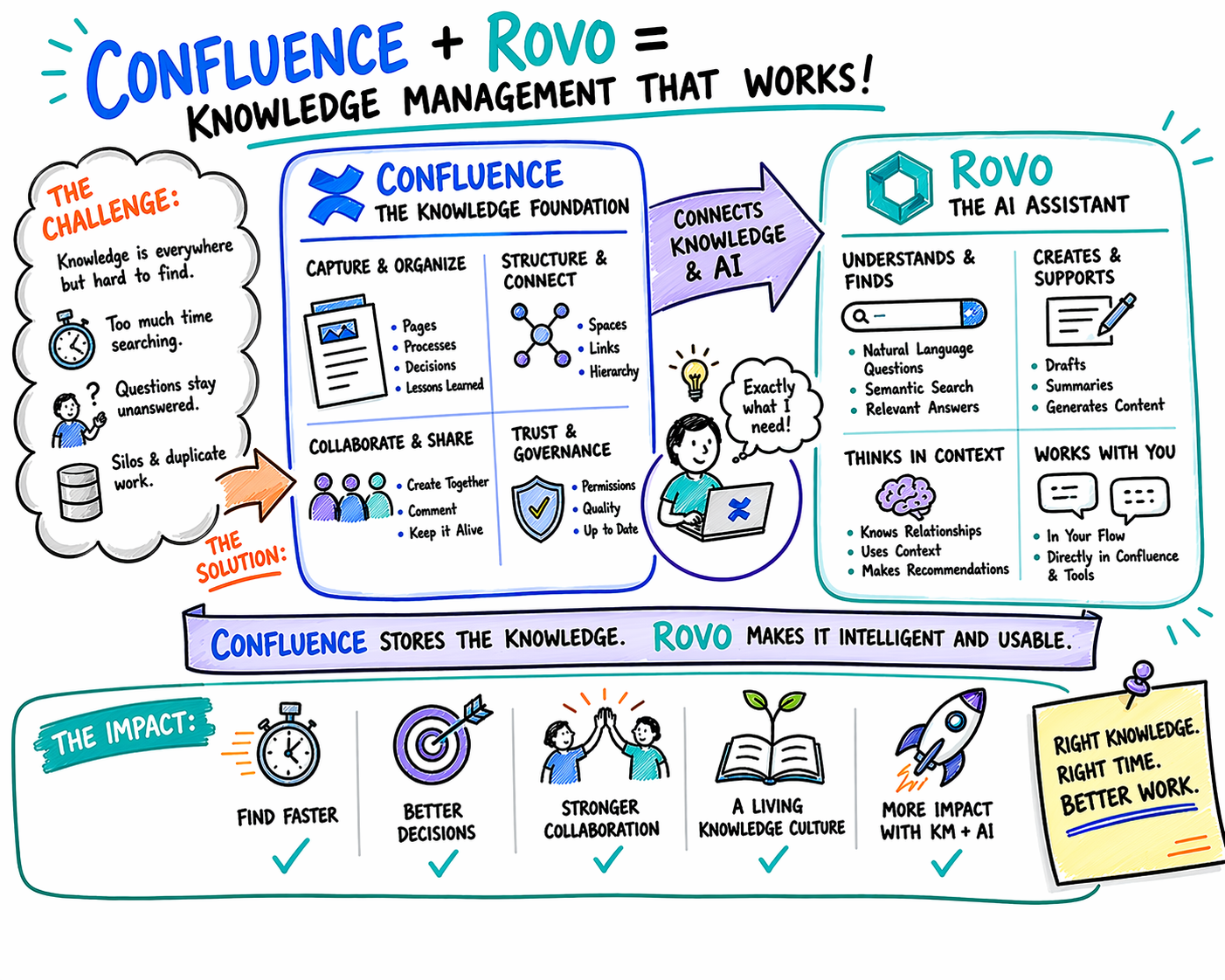
Much of what was discussed in London is not an abstract future problem for our customers. It is already tangible today.
Confluence is the central knowledge platform for many organizations – but often without the structure needed to make knowledge truly actionable. Missing taxonomies, unclear ownership, grown silo structures: these are exactly the problems discussed at KMWorld Europe. And they are the problems we work on solving daily – from space structure to metadata governance to templates that make knowledge capture a habit instead of an extra task.
Atlassian Rovo brings AI directly into this context. Rovo searches and connects knowledge from Confluence, Jira, and connected third-party sources – but its quality stands or falls with the quality of the underlying knowledge base. A poorly structured Confluence delivers poorly structured answers. The "Trust Gap" is not a theoretical risk with Rovo – it is measurable as soon as you start using Rovo seriously.
Swarmit helps companies create exactly this foundation: building KM structures that are AI-ready. Setting up Confluence so that knowledge is not just stored but found and used. Introducing Rovo on a basis that enables reliable, context-rich answers. And anchoring Lessons Learned and Communities of Practice as living processes – not one-off projects.
Those who invest in knowledge structure today simultaneously invest in the quality of every AI answer built on it tomorrow.
KMWorld Europe 2026, April 14–15, America Square Conference Centre, London


.webp)


